Lithosphere: Oceanic vs. Continental

ESS 314 · Geophysics · Lecture 26

with plate-boundary kinematics

Marine Denolle — University of Washington

By the end of this lecture

  • Derive the half-space cooling model and predict bathymetry and heat flow from seafloor age
  • Identify the five definitions of the lithosphere base — and why they disagree
  • Build the oceanic vs. continental comparison across eleven attributes
  • Classify plate boundaries and balance plate-motion vectors with circuit closure
ESS 314 · Lecture 26

What is the lithosphere?

  • A rigid outer shell — but where does it end?
  • Seismic, thermal, elastic, mechanical, chemical definitions
  • Under oceans they agree; under old cratons they differ by 200 km
  • Module 7 uses every method in the course at once

What do we mean by "the lithosphere," and why does the answer change with the observable we use?

ESS 314 · Lecture 26

Oceanic lithosphere = a cooling boundary layer

  • Hot mantle rises at the ridge, cools as it spreads away
  • Cold layer thickens with age,
  • Mechanical boundary layer (C) vs thermal (C)
  • The gap between them is why "lithosphere" is ambiguous
ESS 314 · Lecture 26

Key equations — half-space cooling

  • Bathymetry deepens as ; heat flow decays as
ESS 314 · Lecture 26

HSC vs. the plate model

Takeaway — HSC fits young seafloor; the plate model is needed past ~70 Ma, where depth and heat flow flatten.

ESS 314 · Lecture 26

The lithosphere is not one thing

Takeaway — Under cratons, four "lithosphere bases" disagree by ~200 km. The base is a behaviour, not a surface.

ESS 314 · Lecture 26

Real data is one xarray call away

Takeaway — Müller/Seton age grid — inspect metadata first, plot, cite the data.

ESS 314 · Lecture 26

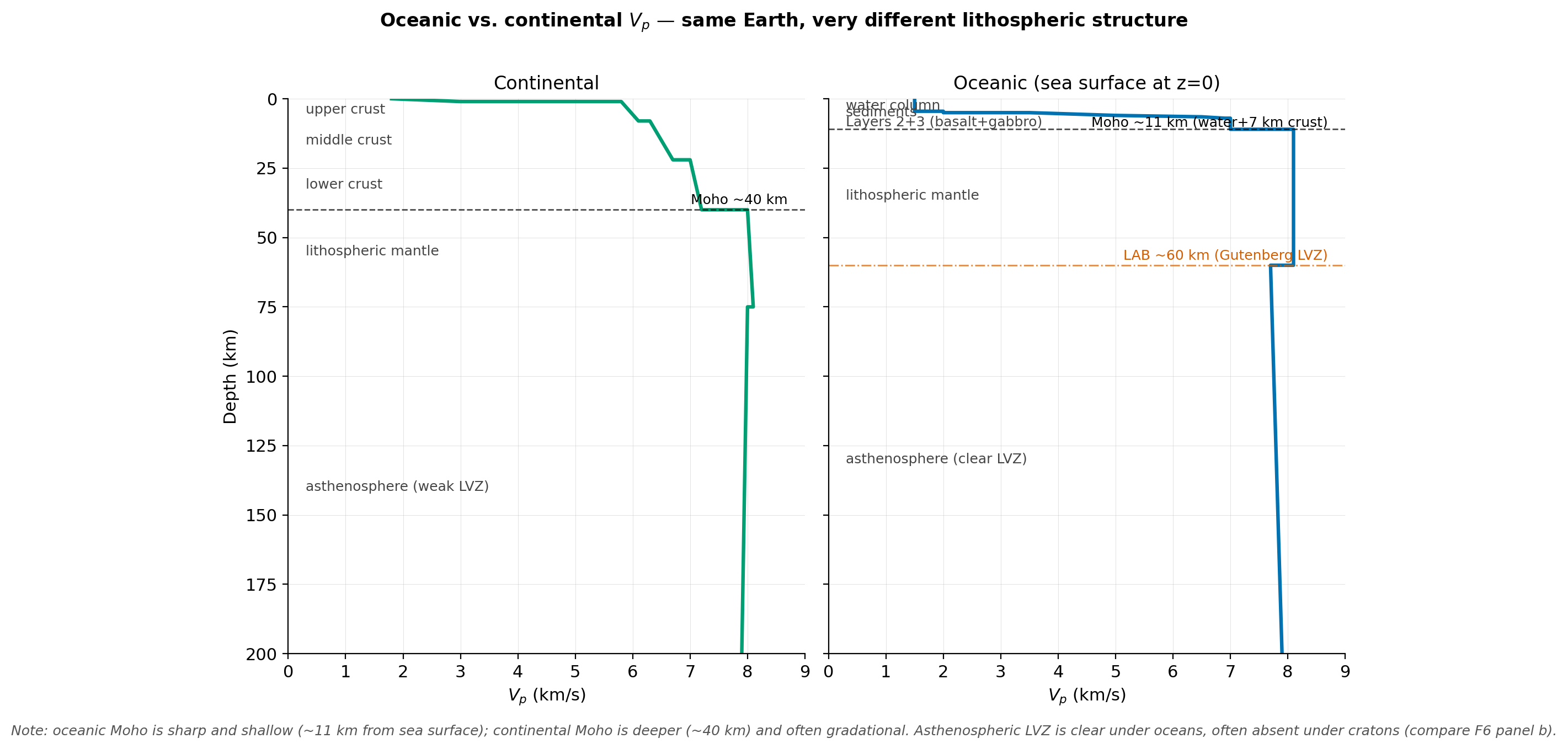
Oceanic vs. continental: structure

Takeaway — Oceanic: thin, mafic, sharp ~11 km Moho. Continental: thick, felsic, gradational ~40 km Moho.

ESS 314 · Lecture 26

The comparison in one breath

  • Oceanic: young, homogeneous, dense → recycled
  • Continental: ancient, heterogeneous, buoyant → preserved
  • Density and chemistry decide who subducts
  • Eleven attributes, one story: conveyor vs. raft
ESS 314 · Lecture 26

Three kinematic classes of boundary

Takeaway — Divergent / convergent / transform — set entirely by the relative-velocity vector.

ESS 314 · Lecture 26

Relative velocity is frame-independent

Takeaway — Fix either plate — is the invariant. Watch half-rate vs. full-rate for spreading.

ESS 314 · Lecture 26

Transform faults vs. fracture zones

Takeaway — Only the segment between ridge tips is active. Slip sense is opposite to the ridge offset.

ESS 314 · Lecture 26

Circuit closure recovers the unknown

Takeaway — Rigid plates close the loop: . (Polarity is not fixed by kinematics.)

ESS 314 · Lecture 26

You are sitting on Siletzia

Takeaway — An accreted Eocene oceanic plateau — gravity high + magnetic stripes — that shapes Puget Lowland hazard.

ESS 314 · Lecture 26

AI literacy — grade the derivation

  • Prompt an AI to derive the HSC bathymetry model from the heat equation
  • Check: boundary conditions · isostasy · the prefactor · the 70-Ma limit
  • A plausible derivation can be wrong on any of these
  • An AI is a reasoning partner, not an oracle
ESS 314 · Lecture 26

Concept check

  1. HSC ocean depth at Ma? Surface heat flow at the same age?
  2. Why do four "lithosphere bases" disagree beneath a craton?
  3. Classify a boundary whose relative velocity makes with the strike.
  4. Confirm circuit closure for the 3-4-5 triangle of the triple junction.

Worked vector algebra: notebooks/plate_motion_vectors.ipynb

ESS 314 · Lecture 26

Next: Ridges and Rifts (L27)

where the oceanic lithosphere of this lecture is born