Convergent Plate Boundaries

Subduction & Collision

ESS 314 · Geophysics · Lecture 28

Marine Denolle — University of Washington

By the end of this lecture

  • Describe subduction-zone anatomy and the Chilean ↔ Mariana continuum
  • Use age, rate, and sediment to classify a margin — and test the maximum-magnitude hypothesis
  • Interpret the depth-varying rupture domains (seismicity, tsunami, strong motion)
  • Explain why young, slow Cascadia is nonetheless -capable
ESS 314 · Lecture 28

Subduction zones host every

Takeaway — Every great earthquake is on a megathrust — but the giants scatter across margins of very different age and rate.

ESS 314 · Lecture 28

A rule that data dispelled

  • Ruff–Kanamori (1980): old + fast ⇒ strong coupling ⇒ great earthquakes
  • Sumatra 2004 (old, slow) →
  • Tōhoku 2011 (where was thought "impossible") →
  • Age and convergence rate do not set the maximum magnitude

What controls how large a subduction earthquake can be — and why were the obvious parameters wrong?

ESS 314 · Lecture 28

The slab is a cold, dense sinker

  • Cold, thick, old lithosphere → negative buoyancy
  • Basalt → eclogite transition adds density at depth
  • Slab pull is the dominant plate-driving force
  • This is why old slabs looked like the big-quake recipe
ESS 314 · Lecture 28

Two end-member modes

Takeaway — Coupling and dip set the style: Chilean (shallow, coupled, shortening) ↔ Mariana (steep, weak, extension).

ESS 314 · Lecture 28

The thermal parameter

  • Combines age , convergence rate , and dip
  • A measure of how cold the slab stays as it descends
  • Large → deep seismicity, the "strong-coupling" expectation
  • Hold onto it — the data will test it
ESS 314 · Lecture 28

What limits the largest earthquake?

  • Maximum magnitude is set by rupture area (), not slab age
  • Wide + long + strongly locked ⇒ great earthquake
  • The controls are geometric
ESS 314 · Lecture 28

Depth-varying rupture domains

Takeaway — Shallow domain A → tsunami; downdip domain C → strong ground motion. A margin's hazard depends on which domains it has.

ESS 314 · Lecture 28

The recipe, tested against data

Takeaway — Age & rate (top) don't order ; seismogenic width () & flatness () do (Wirth 2022).

ESS 314 · Lecture 28

What actually controls

  • Seismogenic width & dip — strongest; needs width km, needs km
  • Downdip curvature — flat megathrusts rupture biggest
  • Secondary: sediment smoothing, roughness, fluids, upper-plate strain
  • Working assumption: any mature megathrust may be
ESS 314 · Lecture 28

Dip controls the back-arc

Takeaway — Steep dip () → back-arc extension; shallow dip () → upper-plate shortening.

ESS 314 · Lecture 28

Three margins, three verdicts

  • Chile — old-ish, fast, coupled → recipe works ( in 1960)
  • Mariana — very old but steep, narrow zone → no great EQ
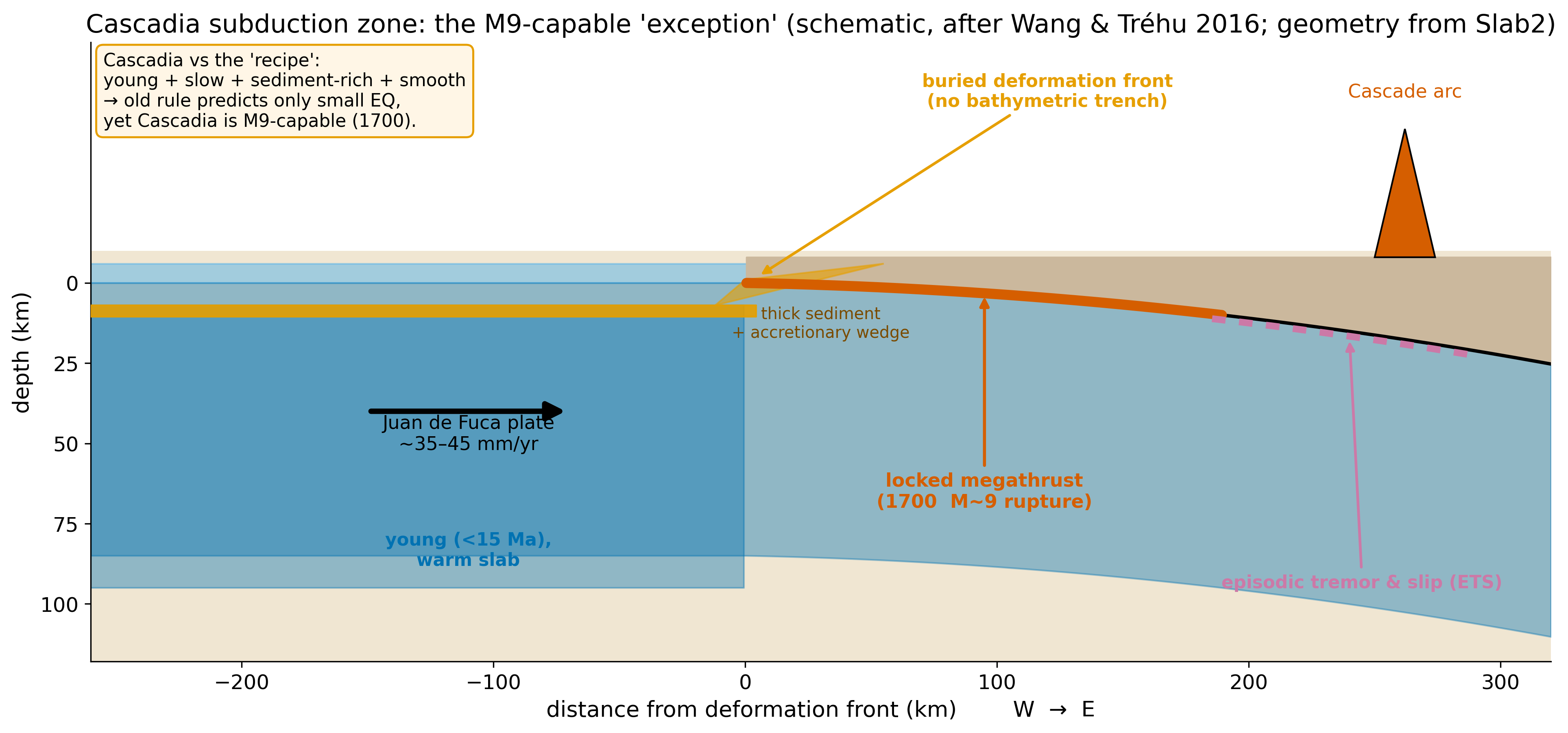
  • Cascadia — young, slow → recipe says "small"... yet (1700)
  • One scheme can't fit all three ⇒ the controls were wrong
ESS 314 · Lecture 28

Cascadia: the -capable exception

Takeaway — Young, warm, slow, sediment-rich, smooth — yet locked, and it ruptured in January 1700.

ESS 314 · Lecture 28

Zooming out: the convergence spectrum

Takeaway — Buoyancy of the incoming material sets the mode: ocean subducts; arcs & continents collide (Taiwan, Himalaya).

ESS 314 · Lecture 28

AI literacy — the confident, outdated answer

  • Ask an AI: "how do age and rate set the maximum subduction earthquake?"
  • It may recite the dispelled 1980 rule — fluently and confidently
  • Grade it: Does it cite Sumatra / Tōhoku? Does it give the modern controls?
  • You catch this with domain knowledge, not better prompting
ESS 314 · Lecture 28

Concept check

  1. Compute for Tōhoku vs. Mariana — which slab is colder? Which is bigger?
  2. Rupture area and length for ( GPa, m, km)?
  3. Name two "high-recipe" margins with no great earthquake — why not?
  4. Why is Cascadia regarded as -capable? Cite two second-order controls.

Interactive classification: notebooks/subduction_parameter_space.ipynb

ESS 314 · Lecture 28

Next: Transforms & Intraplate (L29)

the third boundary class — and where the rigid-plate assumption breaks