
Ray Theory I: Snell’s Law and the Ray Parameter#
Learning objectives#
After this lecture, students should be able to:
Explain why seismic rays bend in layered media using travel-time arguments.
Define and interpret the ray parameter ( p ) physically and geometrically.
Predict qualitative ray paths in velocity structures that increase with depth.
Relate ray geometry to observable quantities such as travel-time curves.
Context and scope#
This lecture introduces the conceptual core of ray theory. We focus on geometry and timing, not amplitudes or full wavefields.
Ray theory is a high-frequency approximation: it describes where energy travels, not how waveforms interfere. Despite its limitations, it underpins:
Earthquake location
1-D and 3-D travel-time tomography
Phase identification at local and global scales
This material corresponds primarily to Shearer (2009), Chapter 4.1–4.2.
1. Plane waves and interfaces: the physical picture#
Consider a plane seismic wave propagating through a homogeneous medium. Wavefronts are surfaces of constant phase, and rays are normal to wavefronts.
When such a wave encounters a horizontal interface, two constraints must be satisfied:
Continuity of arrival time along the interface
Stationarity of total travel time between source and receiver (Fermat’s principle)
These constraints force rays to bend.
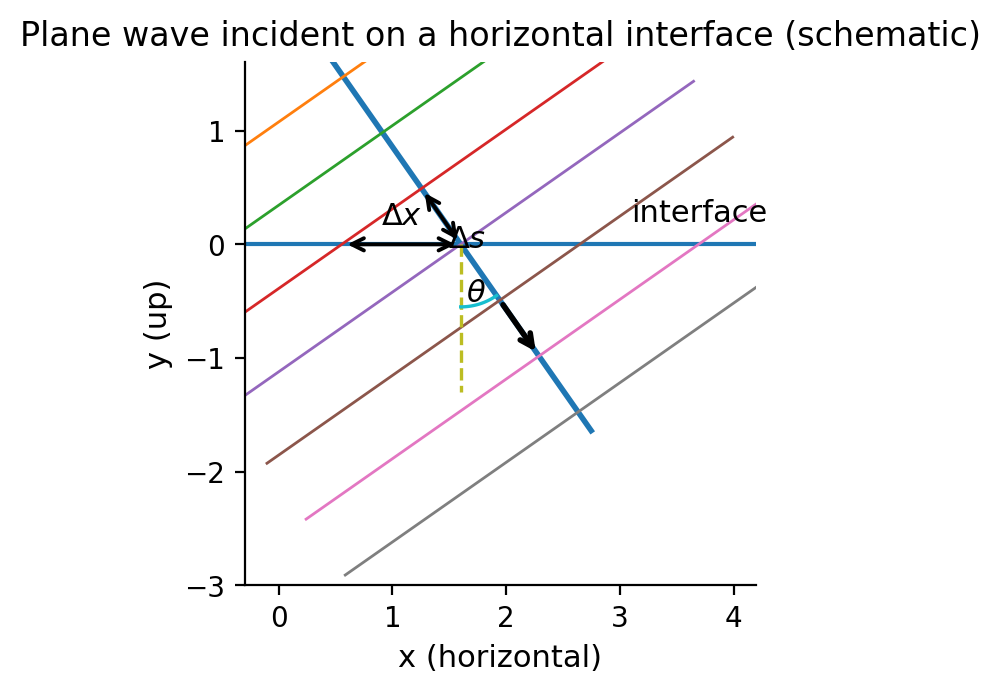
Fig. 1 Plane wave incident on a horizontal interface. The ray angle θ is measured from vertical, and wavefront spacing Δs relates to horizontal spacing Δx through the ray parameter.#
2. Derivation of Snell’s law (seismological form)#
Let:
\(v\) be seismic velocity
\(u = 1/v\) be slowness
\(\theta\) be the ray angle measured from vertical
From geometry of successive wavefronts:
This quantity \(p\) is called the ray parameter.
Across a horizontal interface:
This is Snell’s law, written in seismological form.
📖 Shearer reference: Fig. 4.2 (Snell’s law across layers)
Physical interpretation (critical)#
The ray parameter \(p\):
Is the horizontal slowness of the wave
Equals the slope of the travel-time curve: $\( p = \frac{dT}{dX}\)$
Is conserved only in laterally homogeneous media
This is why ray theory works so naturally for layered Earth models.
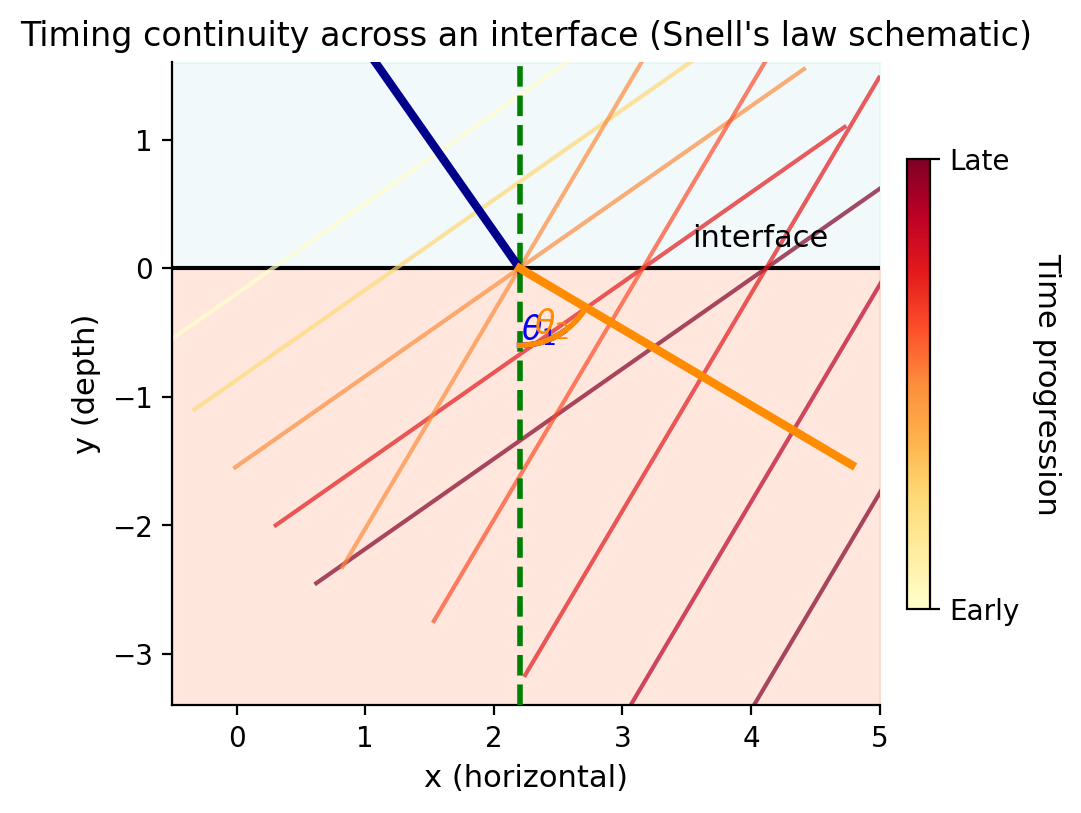
Fig. 2 Snell’s law as timing continuity. Wavefronts (colored by time progression from early to late) bend across the interface, preserving arrival time continuity. The ray parameter p = u sin θ remains constant across the boundary.#
3. Rays in media with velocity increasing with depth#
In the Earth, both \( V_P \) and \( V_S \) generally increase with depth.
Because \( p = u \sin\theta \) is constant:
As \( u \) decreases with depth
\( \sin\theta \) must increase
Rays bend away from vertical
Eventually, \( \theta = 90^\circ \), defining a turning point.
📖 Shearer reference: Fig. 4.3 (curved rays and turning points)
Key consequences#
Steep rays (small \( p \)) turn deeper
Shallow rays (large \( p \)) turn near the surface
Far-offset arrivals sample deeper Earth structure
This single idea explains why travel-time curves encode depth information.
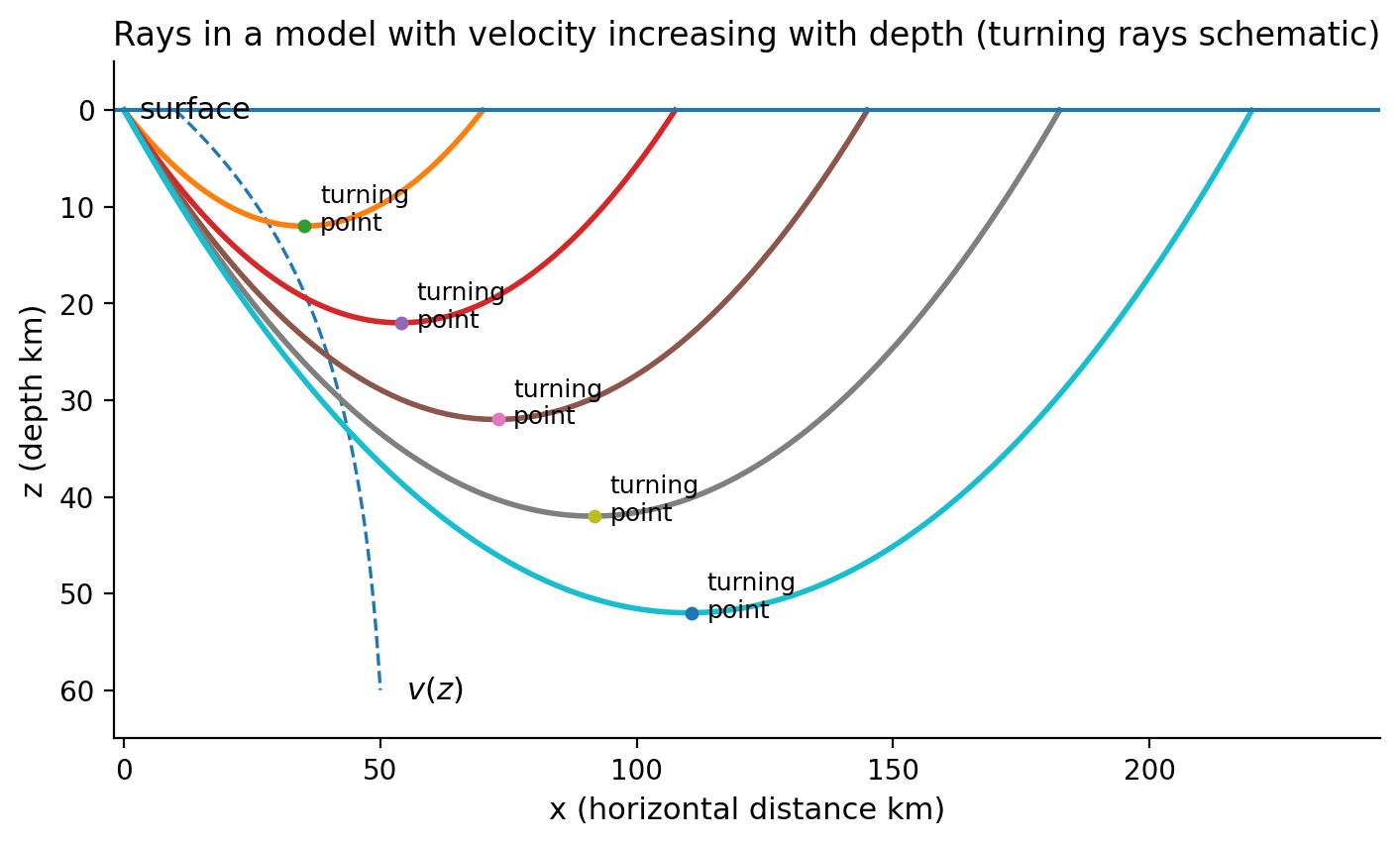
Fig. 3 Ray paths in a model with velocity increasing with depth. Rays with different takeoff angles (different ray parameters p) turn at different depths. Steeper rays (smaller p) penetrate deeper before returning to the surface.#
4. Ray parameter and travel-time curves#
Each observed arrival at distance \( X \) corresponds to one ray with a specific \( p \).
Plotting first-arrival time versus distance produces a travel-time curve:
The slope at any point is:
📖 Shearer reference: Fig. 4.4 (travel-time curve and ray parameter)
Conceptual inversion#
Observations: \( T(X) \)
Slopes give: \( p(X) \)
Geometry + physics link \( p \) to turning depth
This is the foundation of travel-time inversion.
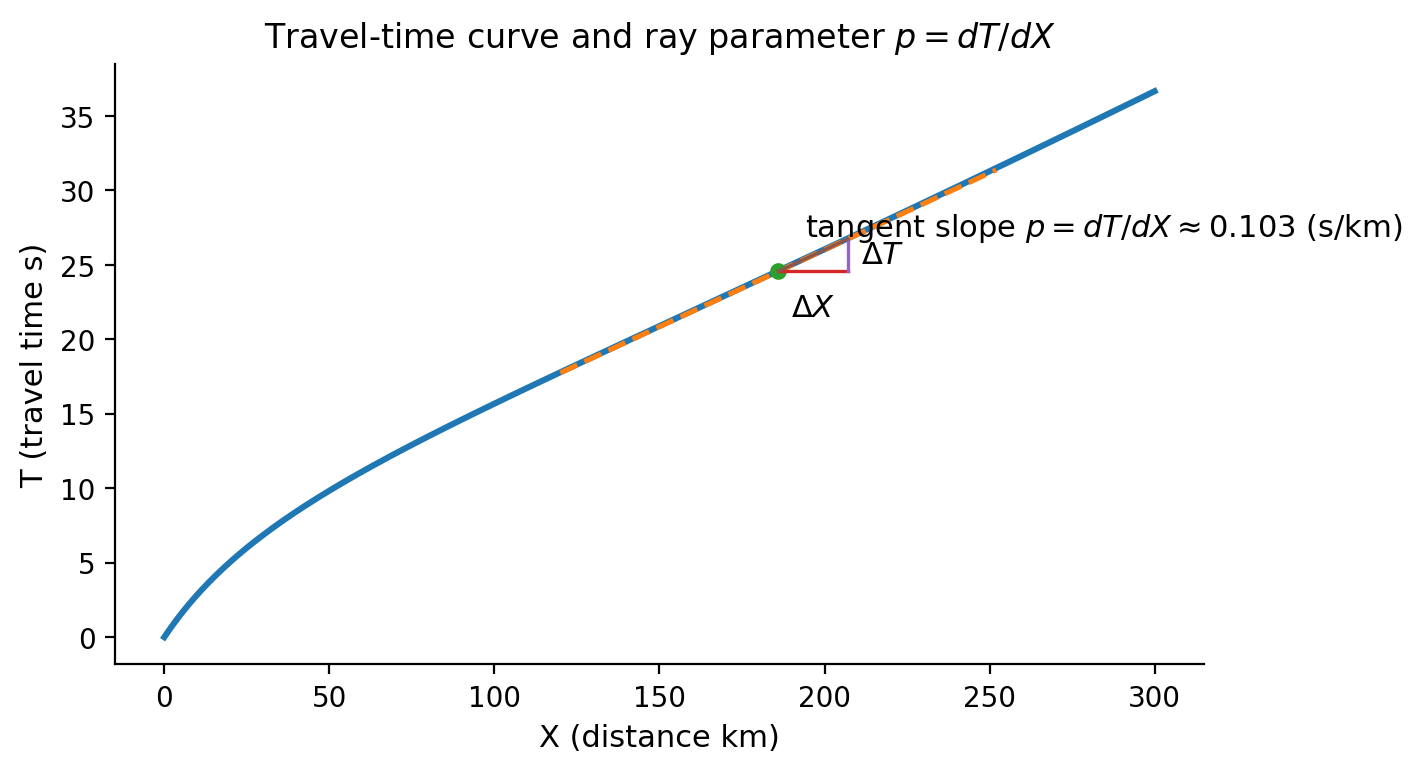
Fig. 4 Travel-time curve T(X) and ray parameter. The slope of the tangent line at any point equals the ray parameter: p = dT/dX. This geometric relationship connects observable travel times to ray paths.#
5. Check-your-understanding (conceptual)#
Q1. Two P-wave arrivals are recorded at different distances. One has a smaller \( dT/dX \) than the other.
Which ray turned deeper?
Which ray sampled higher velocities?
Q2. If velocity were constant with depth, would rays ever return to the surface? Why or why not?
Q3. Why is \( p \) no longer constant in laterally varying velocity models?
Students should answer these before seeing numerical ray tracing.
What we deliberately did not do#
No full derivation from the eikonal equation
No amplitudes, caustics, or head waves yet
No spherical geometry yet
Looking ahead#
Next, we will:
Turn these ideas into numerical ray tracing
Explore when ray theory fails (LVZs, triplications)
Extend the ray parameter concept to the spherical Earth
Reading#
Shearer, P. M. (2009), Introduction to Seismology, 2nd ed. Chapter 4.1–4.2 (Snell’s law and ray paths)